Published: 20 October 2026
In my previous blog, I discussed how AI has helped us build the scientific tools and workflows within the BioAscent In Silico Workbench. The challenge we set ourselves was to create a tool to help scientists make the best possible design decisions while preserving the evidence and reasoning behind them. One example of this is the Proximity Portal, which applies this approach to the design and assessment of PROTACs.
A PROTAC contains one ligand that binds the Protein Of Interest (POI), another that recruits an E3 ligase, and a linker connecting the two. The linker is not simply an inert piece of molecular string - changes to its length, composition and attachment geometry can affect the properties and behaviour of the complete molecule. In practice, linker optimisation can quickly become a combinatorial problem. Numerous attachment points, linker lengths and linker chemistries may appear plausible on paper, yet only a small fraction are likely to balance degradation activity, physicochemical properties and synthetic tractability. Exploring these possibilities systematically is difficult using intuition alone.
The BioAscent Proximity Portal
The Proximity Portal combines attachment-aware linker generation with medicinal chemistry transformations derived from published PROTAC optimisation series. The workflow retains both ligands and their attachment vectors, explores alternative linkers and records the transformations used to produce each design (Figure 1). The challenge here is not generating the largest possible number of linkers; producing thousands of structures is technically easy. Producing a smaller number that a medicinal chemist might seriously consider is much more useful.
The resulting complete PROTAC designs are then assessed using two complementary approaches. A beyond-Rule-of-Five (bRo5) score considers the balance between molecular weight, topological polar surface area, hydrogen-bond donors and rotatable bonds. A separate, benchmark-purged medicinal chemistry score considers linker geometry, adaptability, non-overlapping degrader precedent and computational retrosynthetic accessibility. The two assessments are deliberately kept separate. No single score captures everything important in PROTAC design, and neither score predicts experimental success. Their purpose is to provide transparent and complementary information that scientists can examine during prioritisation.
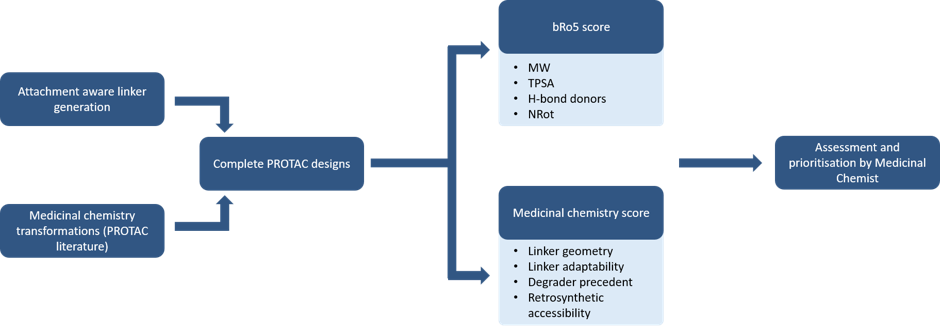
Figure 1. PROTAC linker generation workflow
The published Kymera IRAK4 degrader series provided a practical test of the workflow. Rather than asking whether the workflow could invent completely novel structures, we asked a more practical question: could it recover optimisation decisions that experienced medicinal chemists had already made and experimentally validated?
Starting from Compound 13 in the paper, the Proximity Portal generated Compounds 14 to 17 through one-step or two-step linker changes (Figure 2). All four appeared within the top 100 of 173 generated designs using the bRo5 assessment, while the medicinal chemistry score placed KT-474 second. Although a retrospective exercise can never prove that a workflow will identify the best future compounds, this test case provides strong evidence that the system is able to prioritise chemically sensible directions that align with successful medicinal chemistry optimisation.
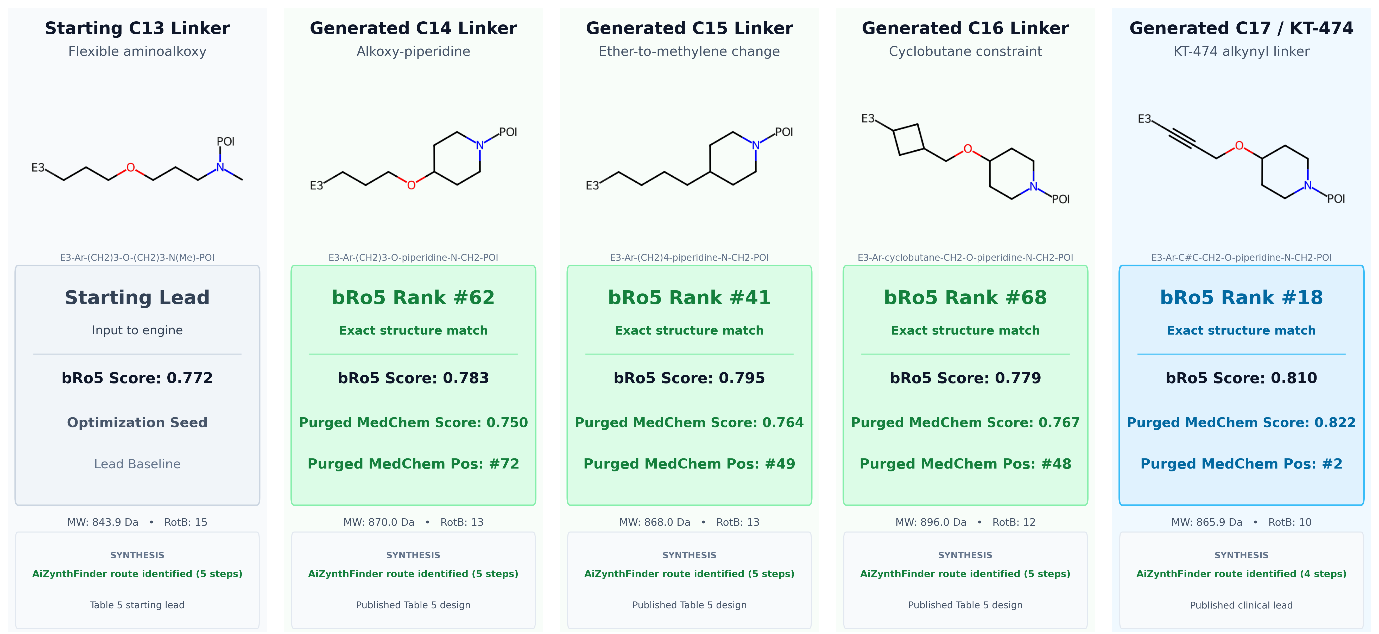
Figure 2. Starting from Compound 13 in the published Kymera Therapeutics IRAK4 degrader study we applied a medicinal chemistry grammar derived from multiple PROTAC optimisation series to guide attachment-aware Markov linker generation.
From computational design to medicinal chemistry decisions
Though useful, the ranking is not the main point. Most importantly the workflow allows scientists to see what changed, how each structure was generated and which factors contributed to its assessment. A computationally proposed design or synthetic route remains evidence for discussion, not proof that a compound should be made or that the chemistry will work. This is where medicinal chemistry judgement becomes essential.
The Proximity Portal can generate designs, calculate properties and preserve the reasoning behind a proposed linker change. Whether those outputs are useful, however, depends on how well they support real compound-design decisions.
Questions such as synthetic tractability, intellectual property considerations, assay results and broader programme objectives still require scientific interpretation. The most useful computational tools are therefore not substitutes for medicinal chemists, they are decision-support systems that help scientists evaluate options more systematically.
“The Proximity Portal provides a practical framework for exploring PROTAC linker modifications, ranking them, and identifying the most promising ideas. We can rapidly review the compounds generated and use that information alongside project knowledge and medicinal chemistry experience to guide discussions around the best path forward for the project.”
Lindsay Robinson, Team Leader, Chemistry at BioAscent
The Proximity Portal represents just one example of how the BioAscent In Silico Workbench is being used to support drug discovery projects. Rather than focusing on AI as a standalone technology, we have integrated computational methods into our scientific workflows, making calculations easier to run and helping teams explore design options more efficiently. In the end, the objective is not to replace scientific judgement, it is to provide better tools for exercising it.
Meet the Expert
Angelo Pugliese is Associate Director of In Silico Discovery at BioAscent. An expert in structure- and fragment-based methodologies applied to drug design with a passion for machine learning, Angelo has over 20 years’ experience working as a computational chemist, including leading the computational chemistry and artificial intelligence team at the drug discovery unit at the Beatson Institute for Cancer Research and a PhD in computational chemistry from the University of Nottingham.