Published: 16 October 2026
The less visible role of AI in scientific knowledge, coding and drug discovery workflows.
When I wrote about generative molecular design in 2019, before “generative chemistry” became the standard label, most of the attention was on the molecules. Could a machine learning model generate a valid chemical structure? Could it optimise several properties at once? Would it eventually design a drug?
These are still important questions; molecules, after all, are quite useful in small-molecule drug discovery.
But over the last few years, we have used AI at BioAscent for much more than molecular generation. Large language models (LLMs) have helped us to search and organise scientific knowledge, write and test code, debug applications, document methods, develop interfaces and build the BioAscent In Silico Workbench – more on that later.
Does this mean accepting whatever an LLM produces? Absolutely not.
AI can write useful code very quickly. It can also produce convincing nonsense at impressive speed, and hallucinations are never far away. I once asked an AI to code a formula and discovered only a week later that the reported values were being retrieved from a pre-filled table. No calculation was taking place at all. The lesson was simple: code that runs is not necessarily code that is scientifically correct. I should have checked it more carefully.
Experiences like this taught me the importance of giving AI clear guardrails. AI coding tools can read instruction files that describe a project and define how the agent should work, providing the AI with persistent instructions rather than repeating them in every prompt. In a scientific project, these files can define the architecture of the application, identify trusted data sources, specify which calculations must be implemented and describe the tests that the code must pass. Importantly, they can establish clear rules: do not fabricate results, do not replace a requested calculation with a convenient shortcut, preserve data provenance, make assumptions visible and clearly distinguish measured values from predictions.
These guardrails do not make hallucinations disappear unfortunately. The AI can still misunderstand a requirement or produce code that looks correct but implements the wrong method. The code must still be executed, tested against known examples and inspected scientifically.
This raised an important question: how do you take useful computational methods and make them accessible to a wider scientific team without sacrificing scientific rigour? This challenge influenced the development of the BioAscent In Silico Workbench (Figure 1). With scientific direction, explicit guardrails, testing and review, AI can help us do much more than run models or generate molecules. It can help us build the tools and workflows around them.
AI helps us build the tools
Many useful computational methods remain confined to specialist scripts and notebooks. The science may be excellent, but the broader impact is limited if only the person who wrote the code can use it. The BioAscent In Silico Workbench connects a central Hub with specialist applications covering molecular modelling, data analysis, AI, molecular design and scientific intelligence.
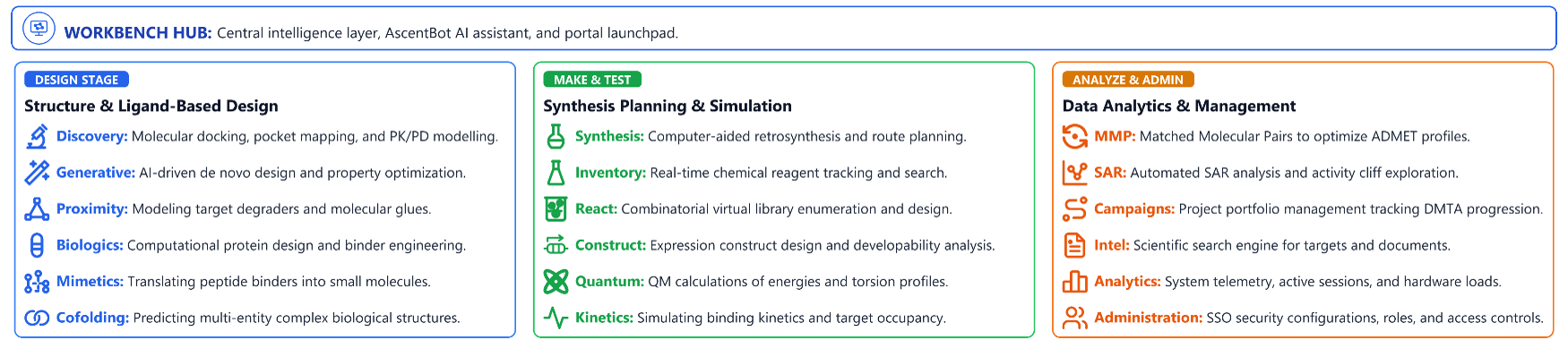
Figure 1. Architecture of the BioAscent In Silico Workbench. The Workbench Hub provides a common entry point, an AI assistant and a central intelligence layer across the platform. The connected portals are organised around three parts of the discovery workflow: Design, covering structure- and ligand-based molecular design; Make & Test, covering synthesis planning, library construction and molecular simulation; and Analyse & Admin, covering scientific intelligence, SAR and matched molecular pair analysis, project data, system analytics and platform controls. This organisation allows specialist computational methods to remain distinct while operating within a shared and connected environment.
We designed the Workbench around three simple principles:
Access: make advanced computational methods easier for discovery scientists to use
Connect: bring design, analysis and evidence together in coherent workflows
Protect: maintain full control of confidential data, intellectual property and scientific calculations, which is paramount for a CRO
The modular structure of the Workbench was important; each portal has a specific scientific purpose, its own inputs and outputs, and its own validation requirements. The portals can share data and infrastructure without pretending that docking, retrosynthetic planning, SAR analysis and scientific intelligence are variations of the same problem. Connecting methods does not remove their individual assumptions or limitations.
Some people might describe this process as "vibe coding". I prefer the term human-directed, AI-assisted development, because every application still begins with a scientific problem and depends on scientific oversight.
The process was not:
Prompt → code appears → code accepted
It was closer to:
Scientific problem → explicit requirements → AI-assisted implementation → execution → testing → review → correction → integration
The value of AI was therefore not limited to producing individual pieces of code. It helped shorten the distance between a scientific idea and a working, testable application. This allowed useful methods to move beyond personal scripts and notebooks and become tools that other scientists could inspect, challenge and use.
AI will continue to generate molecules, but its contribution to drug discovery is already much broader. It can help scientists turn ideas into code, code into usable tools and computational suggestions into evidence that teams can examine and challenge. AI may be another tool in the hands of the drug designer, but it is now also helping us build the drug discovery toolbox. At BioAscent, that means creating platforms such as the In Silico Workbench that make scientific methods more accessible, connected and usable across the discovery workflow.
Meet the Expert
Angelo Pugliese is Associate Director of In Silico Discovery at BioAscent. An expert in structure- and fragment-based methodologies applied to drug design with a passion for machine learning, Angelo has over 20 years’ experience working as a computational chemist, including leading the computational chemistry and artificial intelligence team at the drug discovery unit at the Beatson Institute for Cancer Research and a PhD in computational chemistry from the University of Nottingham.