Published: 17 December 2025
Flow cytometry is an extremely powerful screening technique that can be incorporated into drug discovery screening cascades to provide high-throughput, single-cell-level analysis of multiple biological parameters. Flow cytometry uses lasers to interrogate cells, allowing for their characterisation based on the resulting fluorescence data. Scientists at BioAscent routinely use flow cytometry to carry out complex cell analysis, providing high-quality data for immune profiling, cell cycle analysis, and target validation.
BioAscent run all our flow cytometry experiments on our state-of -the-art Agilent NovoCyte 3000 flow cytometer. This system is equipped with a NovoSampler Pro, allowing for the automation of many of its fluidic functions, leading to an increase in throughput, which allows the team to run 96-well plates or 24 tubes simultaneously.
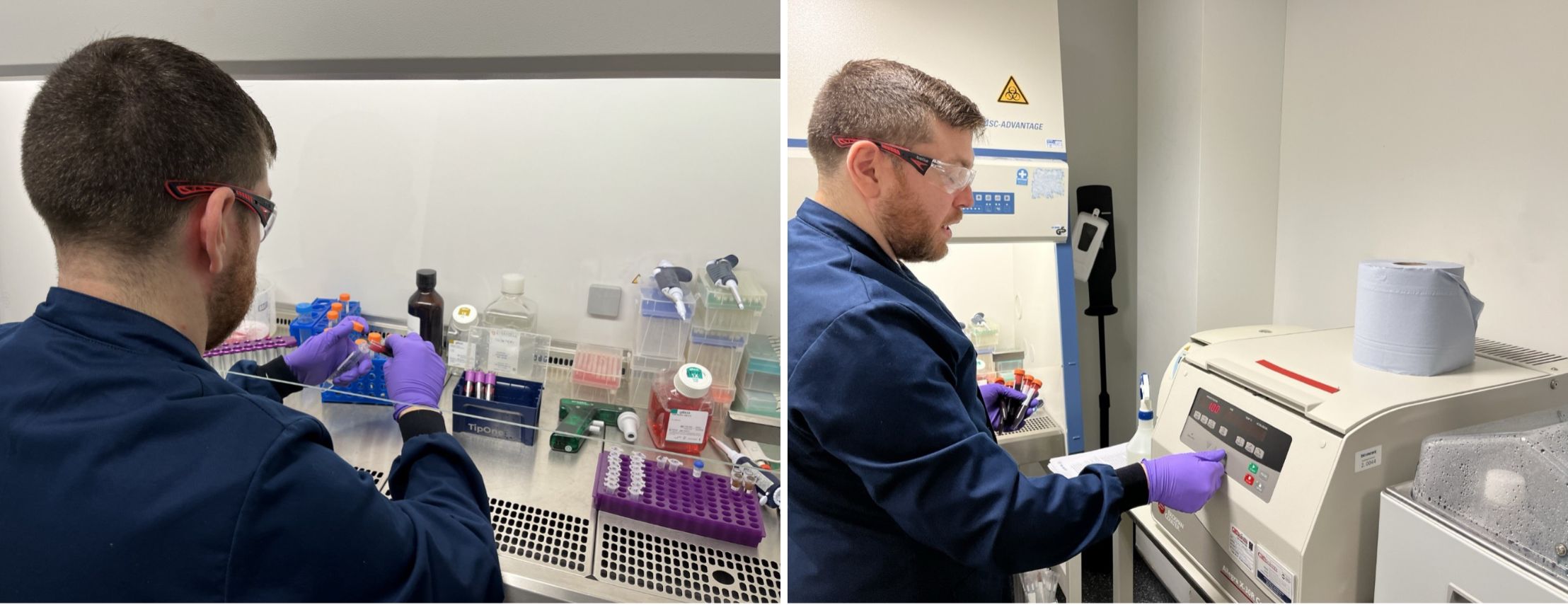
We spoke to Senior Scientist Grant McGregor as he spent the day in the lab carrying out a flow cytometry experiment for a client:
I gained valuable experience in flow cytometry during my 4 years working as a postdoctoral research associate at the Beatson Institute for Cancer Research in Glasgow where I was studying the role of Rab27 in cancer. At BioAscent, I’ve continued building my expertise in this technology and have developed and run flow cytometry experiments for a range of projects.
Today I am running a dose-response curve (DRC) for a client project against basophils isolated from one of our internal BioAscent donors. These donors have all been screened by the team at BioAscent to ensure the highest quality of inputs for our clients and their projects.
Before running the assay, I prepare my compounds using our Echo acoustic dispensers and complete quality checks on our Agilent Novocyte 3000.
9.30AM – Blood arrives from the donor
Whole blood is collected from the anonymous donor by one of our trained Phlebotomists at BioAscent into tubes specific for the application required. It is then delivered to me in the lab.
10AM – Isolate the basophils
For this project we need to isolate the basophils from the donor blood. Basophils are a type of white blood cell which play a key role in the immune system. To study these cells, they need to be separated from the rest of the blood.
To begin the isolation, I add an aggregation agent to the blood and spin the samples on the centrifuge; this separates the red blood cells from the blood plasma. Another spin on the centrifuge allows me to isolate the leukocytes from the plasma.
I isolate the basophils from the leukocytes using magnetic negative immunoselection. We can use this purification technique for a whole range of immune cells, not just basophils.
I now have the basophils isolated! I perform a cell count, and they are ready for use in the assay.
12PM – Test the purity
We must be sure of the purity of the cell population, so the basophils are mixed with a panel of antibodies and incubated before being analysed using our Novocyte 3000. This allows us to ensure that the correct number of cells are added to each well with the clients' samples.
1PM – Run the assay procedure
During our bespoke assay development process, we establish a robust procedure that best suits the needs of our client.
I follow this procedure to carry out the assay, incubating the basophils over a range of different time points with a variety of priming agents, samples of interest and activation agents.
4PM – Stain the cells and run flow cytometry
I use a fluorophore conjugated antibody panel to stain the cells and determine the levels of specific markers on the cell surface.
The cells are now analysed by flow cytometry using our Novocyte 3000 to measure the percentage of activated basophils.
Data analysis
I process and analyse the resulting data. From this we can gain detailed insights into how the basophils have reacted and compare the various compounds that we’ve tested.
The data package is then sent over to the client and together the next steps are agreed.
Get in touch to find out more about how BioAscent’s flow cytometry experts can add value to your project.