De risk programmes, define mechanism of action, and uncover hidden mitochondrial liabilities using physiologically relevant, translational assays.
Mitochondrial profiling to support confident drug discovery decisions
Mitochondria are the powerhouses of the cell, responsible for producing ATP through oxidative phosphorylation (OxPhos) while also playing key roles in cellular signalling, apoptosis, and metabolic regulation. Beyond their well-known function in energy metabolism, mitochondria are now recognised as central players in human health and disease, with mitochondrial dysfunction implicated in cancer, neurodegenerative disorders, metabolic diseases, inflammation, and ageing.
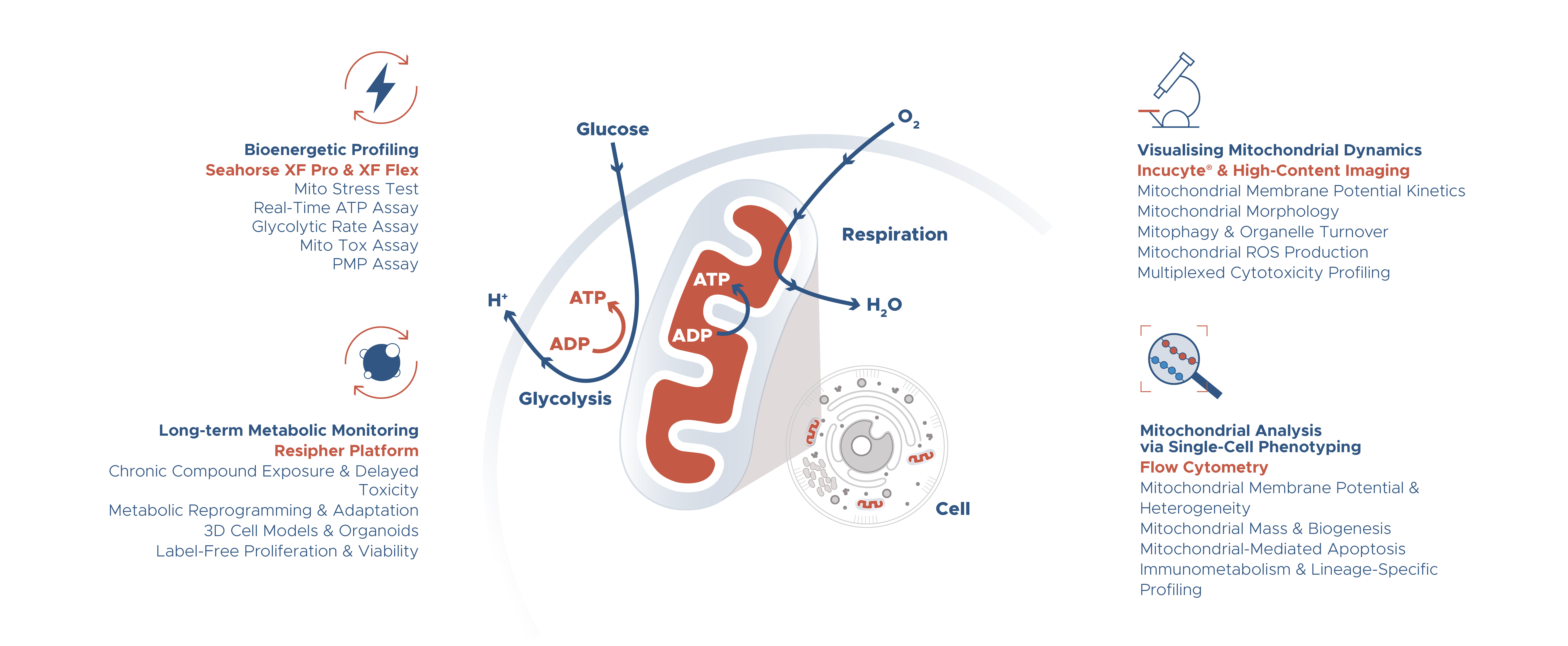
At BioAscent, our scientists use Agilent’s mitochondrial biology platform, Seahorse XF, to answer critical bioenergetic questions and deliver deeper insight into mitochondrial function, enabling more informed decision-making across drug discovery programmes.
Why assess mitochondrial risk early?
Mitochondrial effects can influence compound efficacy, selectivity, and toxicity. Compounds that appear clean in target based assays may ultimately fail due to unidentified mitochondrial liabilities, which are a frequent hidden driver of drug toxicity and late stage attrition. Rather than being treated as a late stage safety check, it is increasingly recognised that assessment of mitochondrial liabilities should be proactively integrated into early-stage screening and optimisation strategies.
BioAscent’s mitochondrial biology platform enables the rapid assessment of compound effects on mitochondrial function, generating actionable data that informs confident decision making and helps de-risk programmes.
Cellular respiration is correlated with ATP synthesis. The rate of OxPhos increases in response to higher cellular energy demand (generating ATP), which consumes oxygen. In cells, metabolic signalling processes that generate ATP (such as glycolysis, amino acid catabolism and beta-oxidation), as well as cellular functions that consume ATP (proliferation, autophagy, biosynthesis etc.), can be reflected by changes in the oxygen consumption rate (OCR).
BioAscent uses Agilent’s Seahorse XF platform to measure OCR in intact cells and isolated mitochondria, allowing us to investigate mitochondrial function in response to pharmacologic inhibitors/effectors or genetic interventions.
Our scientists utilise the Seahorse XF Pro (96-well) system for high-throughput screening and validation of all cell types, and the XF Flex (24-well) platform for 3D-compatible evaluation of organoids and tissues.
De-risk compounds by assessing mitochondrial toxicity prior to in vivo studies
Highly effective for predicting hepatotoxicity or cardiotoxicity in primary cells
Plasma Membrane Permeabilizer (PMP) Assay
Enables direct access of cell-impermeable substrates, biochemical effectors, or test compounds to the mitochondrial machinery without requiring conventional organelle isolation
Acute assays may miss long-term mitochondrial effects that emerge with prolonged exposure. At BioAscent, we employ a 32-channel Resipher system to track dynamic shifts in cellular respiration under true physiological conditions, without disturbing the cells.
Chronic Compound Exposure & Delayed Toxicity
Identification of delayed mitochondrial toxicity, cumulative drug effects, and metabolic adaptation that acute assays may miss.
Metabolic Reprogramming & Adaptation
Tracking of slow metabolic shifts: highly relevant in oncology, immunometabolism, and stem cell differentiation.
3D Cell Models & Organoids
Monitoring of baseline health, growth, and metabolic state of 3D spheroids, primary tissues, and complex co-cultures over extended periods, providing a more translational in vivo-like readout.
Label-Free Proliferation & Viability
Correlation of metabolic output with cell expansion and determination of the exact onset of drug-induced cytostasis or cytotoxicity.
Visualisation of mitochondrial dynamics - live-cell imaging
BioAscent scientists employ the Incucyte® live-cell analysis system and high-content imaging to complement functional bioenergetic readouts. While functional assays measure what the mitochondria are doing, our advanced imaging suite visualises how and where these changes are happening within the cell.
Mitochondrial Membrane Potential (MMP) Kinetics
Utilising fluorescent probes to track the loss or hyperpolarization of the mitochondrial membrane.
Mitochondrial Morphology & Network Dynamics
Evaluation of mitochondrial structural integrity, quantify fragmentation (fission), elongation (fusion), or swelling - key early indicators of metabolic stress, neurodegeneration, or drug-induced toxicity.
Mitophagy & Organelle Turnover
Tracking the clearance of damaged mitochondria by quantifying the colocalisation of mitochondrial and lysosomal markers, critical in neurodegenerative and aging-related disease models.
Mitochondrial ROS Production
Visualisation and quantification of ROS production specifically within the mitochondria, providing direct evidence of oxidative stress.
Multiplexed Cytotoxicity Profiling
Combines mitochondrial readouts with real-time markers, differentiating between multiple mitochondrial toxicity mechanisms.
Multiplexed mitochondrial analysis via single-cell phenotyping - flow cytometry
Novocyte Flow Cytometry provides the statistical power and single-cell resolution needed to identify distinct subpopulations, enabling us to correlate mitochondrial dysfunction directly with cell cycle stage, surface marker expression, or early signs of cell death.
Rapid quantification of MMP across large populations. This is essential for identifying drug-resistant subpopulations or detecting early onset of mitochondrial depolarization before complete cell failure.
Mitochondrial Mass & Biogenesis
Quantification of relative mitochondrial mass per cell. Highly valuable for screening compounds that induce mitochondrial biogenesis or for tracking the depletion of mitochondrial networks.
Mitochondrial-Mediated Apoptosis
Multiplexing mitochondrial depolarization readouts with apoptotic markers allows us to map the precise timeline of mitochondrial-driven cell death, differentiating primary toxicity from secondary necrosis.
Immunometabolism & Lineage-Specific Profiling
Assessment of the bioenergetic state of specific immune cell subsets within a mixed population by co-staining for specific CD markers alongside mitochondrial probes. Important for immuno-oncology and autoimmune drug discovery.
Our mitochondrial assays are highly adaptable and validated across a range of translationally relevant cell backgrounds. Whether you are tracking metabolic reprogramming in immune cells, evaluating safety and hepatotoxicity in primary hepatocytes, or assessing bioenergetic deficits in neuronal models, we tailor our assays to reflect the precise disease indication and target biology.
Mitochondrial Biology Expertise and Drug Discovery at BioAscent
Mitochondrial biology at BioAscent is embedded within a fully integrated drug discovery environment. In addition to functional cellular bioenergetics, we link mitochondrial phenotypes, molecular interaction and target characterisation through:
Protein production
Biochemical and enzymology assays
Biophysics and structural biology
Target validation and mechanism of action support
This integrated approach enables seamless progression from cellular phenotype to mechanistic understanding.
Whether as a standalone service or as part of an integrated discovery programme, our mitochondrial biology capabilities help reduce risk, improve understanding, and accelerate progress toward high quality development candidates.
With over 15 years working in drug discovery Stuart has extensive experience of developing and trouble-shooting novel screening assays, designing screening cascades, compound screening, hit validation and supporting hit to lead and lead optimisation programs. Throughout the 5 years of the European Lead Factory project he held the position of Head of Biology at the European Screening Centre (ESC), leading a team of bioscientists in prosecuting and triaging the output of over 90 high throughput screens across all major target classes and disease indications. Prior to this Stuart helped establish the Dundee Drug Discovery Unit (DDU) where he spent 7 years as a project and then team leader working across a wide array of novel drug targets and assays. He also had a leading operational role in DDU-Industry partnerships with both large pharma and SMEs.
Brian has more than 25 year’s experience in pharmaceutical research & development with over 15 years of those within preclinical drug discovery.
He attained his PhD in Molecular Pharmacology from the University of St Andrews before undertaking post-doctoral positions at the University of Liverpool and University of Glasgow. During this time, he was a co-author or more than 15 peer reviewed publications.
Brian previously worked within Organon, Schering Plough & MSD as a Senior Scientist gaining expertise across a diverse range of technologies, target classes and therapeutic areas. His projects spanned the full range of preclinical research from target discovery to clinical candidate selection.
Laterally Brian led project management teams within contract research and innovation organisations providing services to clients ranging from start-ups to major pharma. As well as managing the teams, he was directly responsible for the successful delivery of over 25 projects.